
The direct-to-consumer (DTC) beauty boom of the 2010s reshaped how consumers discover, shop, and engage with cosmetics. Digital-first brands built loyal communities, bypassed traditional retail gatekeepers, and scaled at remarkable speed, often fueled by venture capital and social media momentum.
But as the industry evolves, the very model that once powered rapid growth is now being tested. Shifting consumer expectations, rising costs, and intensifying competition are forcing many of these brands into rethinking their strategies and, in some cases, their entire business models.
Disruption began with the Covid pandemic. As social distancing and remote work became the new norm, demand for makeup declined sharply, forcing beauty retailers and brands to restructure debt, close physical stores, and, in some cases, file for bankruptcy.
While the beauty sector has since rebounded, the recovery has been uneven. Now, DTC brands are facing a new reality. Growth alone is no longer enough; profitability and discipline matter just as much.
Founded in 2014 as a digital-first brand, Glossier quickly rose to popularity, particularly among Millennial consumers. Its community-driven approach and minimalist aesthetic helped define a new era of beauty marketing.
But despite its early success, the brand now faces the same pressures affecting much of the DTC industry, including slowing growth, rising costs, and the challenge of expanding its customer base.
Glossier confirms store closures
Glossier has confirmed plans to close nine of its 12 stores over the next two-and-a-half years, leaving only three locations open.
This move is part of a broader effort to streamline operations and refocus on long-term profitability. The company has framed the decision as part of a strategic reset to shift away from aggressive physical expansion toward a more selective, performance-driven retail strategy.
Stores remaining open:
- New York City
- Los Angeles
- London
Stores slated for closure:
- Atlanta
- Boston
- Brooklyn
- Chicago
- Dallas
- Washington, D.C.
- Las Vegas
- Philadelphia
- Seattle
Glossier’s leadership changes and operational overhaul
The closures come amid significant internal restructuring.
Colin Walsh assumed the role of Glossier’s new CEO in October 2025, and during his first couple of months in this new position, he has already laid off about one-third of the company’s workforce and canceled previously planned product launches, according to Business of Fashion.
While physical stores once played a central role in defining Glossier’s identity since the opening of its first showroom in New York City in 2016, many newer locations were underperforming.
Third-party retailers have proven more efficient, driving higher sales volumes without the capital-intensive overhead required to operate branded stores.
Today, Glossier products are widely distributed through major global retailers with brick-and-mortar stores, such as Sephora, Space NK, and Mecca. The brand also has a storefront on Amazon, reflecting a broader industry shift toward a large-scale, diversified distribution model.
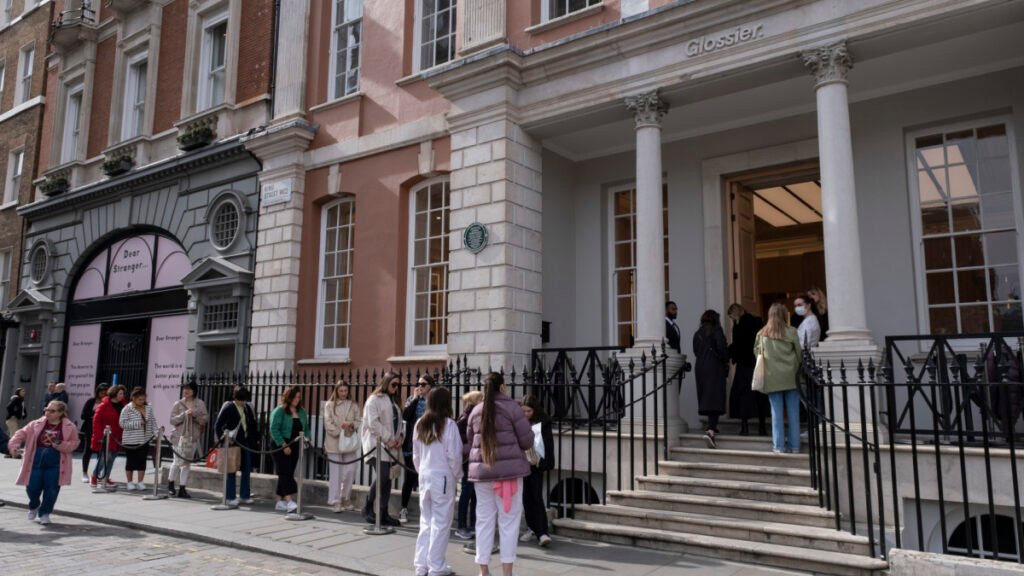
Mike Kemp/In Pictures via Getty Images
Why Glossier is keeping only three stores
The decision to keep just three locations is highly strategic.
Rather than functioning as traditional retail outlets, these stores are being repositioned as experiential hubs designed for events, community engagement, merchandising experiences, and product testing.
According to Walsh, the New York, Los Angeles, and London locations account for 55% of store revenue and 60% of new customers. Concentrating resources on these high-performing markets allows the company to maintain brand presence while improving overall efficiency.
Glossier’s valuation reality check
At its peak in 2021, Glossier was valued at nearly $2 billion, backed by prominent venture capital firms that invested a combined $266 million.
However, that valuation was driven less by financial performance and more by expectations that the company could scale like a technology platform, a narrative often emphasized in press and investor conversations, according to Forbes.
That narrative has since shifted. Glossier’s valuation has declined significantly and is now reportedly below $1 billion.
The company has explored raising additional capital, including a reported attempt to secure $100 million last year and to facilitate secondary shares, according to Puck.
There were also reports of potential acquisition discussions with LVMH in 2024, though no deal ultimately materialized, according to Puck.
The evolving DTC beauty industry
Despite individual brands’ struggles, the global beauty industry remains resilient. Valued at approximately $450 billion, it is projected to grow at an annual rate of 5% through 2030, according to McKinsey & Company’s State of Beauty 2025 Report.
In the U.S., the prestige beauty market rose 2% to $16 billion in the first half of 2025, while sales at mass merchants increased 4% to $34.6 billion, according to Circana.
More coverage on retail store closures:
- 79-year-old fast-fashion leader closing more stores
- 125-year-old retail chain to close more stores in 2026
- 77-year-old jewelry giant will close 100 stores, shut 2 brands
However, growth alone is no longer enough to guarantee success.
Consumers are becoming more selective, prioritizing product performance, value, and transparency. Inflation and greater access to information have raised expectations, pushing brands to stay ahead of trends to avoid being outpaced by the competition.
“A strong uptick in beauty spend, plus higher inflation and greater access to information, has pushed shoppers to pay closer attention to whether products deliver,” said McKinsey & Company industry analysts. “Consumers are selectively splurging across not only consumer discretionary categories but also beauty subcategories.”
For brands, this means faster innovation cycles, sharper positioning, and a deeper understanding of consumer needs.
The rise of retail intermediaries
Another major disruption is the growing dominance of major beauty retailers and marketplaces such as Sephora, ULTA Beauty, and Amazon.
While these platforms provide scale and visibility, they also intensify competition. Brands now compete side-by-side in the same retail spaces, making differentiation more difficult and margins tighter.
For many former DTC disruptors, success increasingly depends on how well they navigate, not bypass, these intermediaries.
Beauty brands struggle to survive
Glossier is far from alone. Across the beauty sector, brands are facing mounting pressure, leading to closures, restructurings, and increased competition for funding.
Several well-known labels have shut down or undergone significant changes in recent years.
Beauty brands that have closed
- Pat McGrath Labs: It put its assets up for auction in late December 2025 and filed for Chapter 11 bankruptcy in 2026, according to Hilco Global and Business of Fashion.
- Flower Beauty: The brand co-founded by actress Drew Barrymore closed in September 2025, according to Global Cosmetics News.
- Beautycounter: Business shut down in April 2024 after entering administration and later rebranded to Counter in 2025, according to Beauty Independent.
- Cover FX and Mally Beauty: Parent company AS Beauty Group closed the beauty labels in January 2026, according to TheStreet.
- Gxve Beauty: The brand founded by music star Gwen Stefani gradually shut down in early 2026, according to Business of Fashion.
The shutdowns of these brands and Glossier’s store closures highlight a broader industry shift in which even the most influential DTC brands must prove they can operate profitably in a more disciplined, retail-driven environment.
Related: 48-year-old nostalgic mall retailer will close 25 stores in 2026