
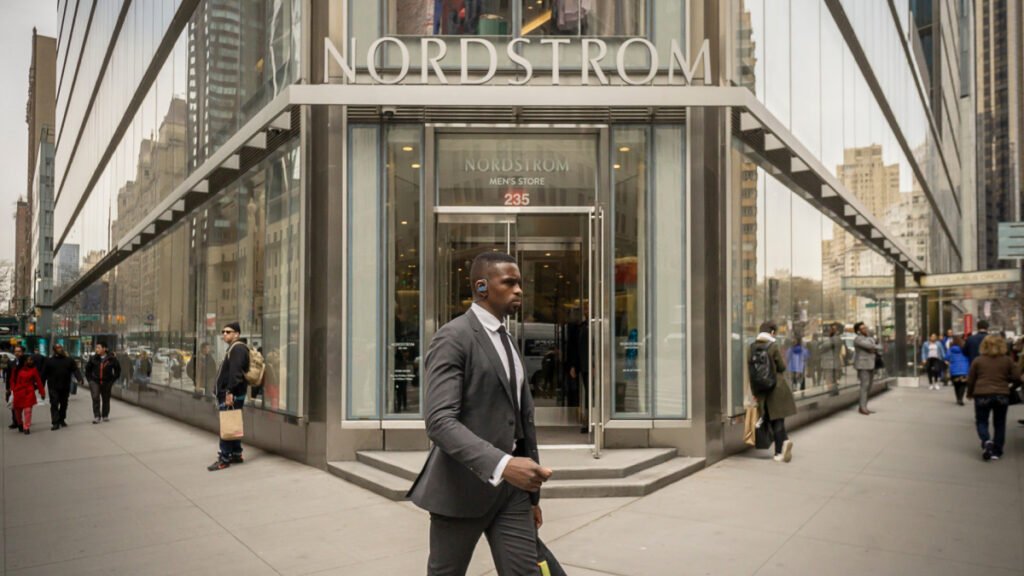
For decades, department stores have defined shopping experiences, offering a convenient one-stop destination where customers can browse multiple brands across a range of price points.
Today, that model is under increasing pressure.
Persistent economic uncertainty has made consumers more selective in their discretionary spending, contributing to weaker sales and declining foot traffic across the retail sector. As a result, even long-established chains are reassessing their physical footprints and closing locations to better align with shifting consumer behavior.
According to CoreSight Research, retailers announced 67% more store closures in 2025 compared to the previous year, a sharp acceleration reflecting the industry’s transformation.
The continued growth of e-commerce has also widened the gap between store closures and openings nationwide, raising the question of whether brick-and-mortar retail will face long-term structural decline.
These challenges are now impacting Nordstrom, one of the most established names in department store retail, which has operated since 1901.
Nordstrom confirms additional store closure in 2026
Nordstrom confirmed it will close two full-line department stores in spring 2026, one at the Galleria Dallas Mall in Texas on May 16 and another at the Christiana Mall in Delaware on April 30.
The Dallas closure will leave the market with just one Nordstrom location and two Nordstrom Rack stores. In Delaware, the shutdown marks a full exit from the state for Nordstrom’s full-line business, leaving only a single Rack location.
These announcements follow the recent closure of a Nordstrom Rack store in Portland, Ore., in January 2026, an uncommon move for a banner that has otherwise been central to the company’s growth strategy.
Nordstrom’s shift toward off-price retail
While Nordstrom is reducing its full-line store footprint, it is accelerating the expansion of its off-price division, Nordstrom Rack.
The company plans to open 23 Rack locations in 2026, maintaining a steady pace after opening 23 in 2024 and 22 in 2025. This consistency highlights Rack’s importance as both a growth engine and a customer acquisition channel.
Nordstrom Co-CEO Erik B. Nordstrom emphasized this strategy during the third-quarter 2024 earnings call, noting that the new Rack stores continue to deliver strong returns while introducing the brand to new shoppers.
“New Rack stores continue to be a great investment for us as they deliver a solid return on capital while attracting new customers,” said B. Nordstrom in the earnings call.
This shift reflects a broader industry trend in which consumers are increasingly gravitating toward value-oriented retail formats, even in traditionally premium segments. Nordstrom is leaning on off-price growth to offset softer demand in higher-priced discretionary categories.
Shutterstock
Ownership changes reshape Nordstrom’s direction
Nordstrom’s strategic pivot comes amid a significant ownership transition.
In early 2025, the Nordstrom family, in partnership with Mexican retail giant El Puerto de Liverpool, reacquired the company in a $6.25 billion deal. The move marked Nordstrom’s return to private ownership for the first time since 1971, with the family now holding a 50.1% controlling stake.
El Puerto de Liverpool, a major player in Latin America’s luxury department store and real estate sectors, brings operational scale and international expertise. While the two companies serve similar customer demographics, their geographic separation allows for a complementary partnership rather than direct competition.
Nordstrom’s strategy
Recent industry disruptions may also be working in Nordstrom’s favor.
Following Saks Global’s Chapter 11 bankruptcy filing in January 2026, along with vendor payment issues and store closures over the past few months, Nordstrom has seen relative gains in customer traffic.
In the first quarter of 2025, Nordstrom saw a 3.3% increase in year-over-year foot traffic, while rivals such as Saks Fifth Avenue and Neiman Marcus experienced declines of around 6%, according to Placer.ai.
Positioning plays a key role. Unlike Saks, which focuses heavily on ultra-luxury designer fashion, Nordstrom offers a broader mix of luxury and contemporary brands, appealing to a wider, more value-conscious customer base.
Although Nordstrom no longer reports quarterly earnings as a private company, its final public report for the fourth quarter of 2024 showed a 3.7% decline in net sales for Nordstrom stores and a 1.2% increase for Nordstrom Rack.
This contrast reinforces the company’s strategic emphasis on off-price retail.
The retail industry remains uncertain
Despite some signs of resilience, the broader retail sector remains volatile.
McKinsey & Company’s State of Fashion 2026 Report projects low-single-digit growth for the global fashion industry, citing ongoing macroeconomic instability, tariff pressures, and value-conscious consumer behavior, particularly in the U.S., where consumer sentiment remained low throughout 2025.
“In the end, 2026 will likely be another year of dislocation for fashion companies,” said McKinsey & Company fashion retail analysts.
Coverage on other retailers that have announced store closure coverage:
- 48-year-old nostalgic mall retailer will close 25 stores in 2026
- 77-year-old jewelry giant will close 100 stores, shut 2 brands
- 106-year-old retail brand operator closing all stores in bankruptcy
Still, some department stores are adapting. Industry experts point to improvements in customer experience, store renovations, and merchandise assortment as key differentiators for legacy retailers working to remain competitive.
As Fortune retail and leadership expert Phil Wahba noted in January 2026, competitors such as Macy’s, Bloomingdale’s, Nordstrom, Belk, and Dillard’s have made measurable progress in upgrading stores and service, efforts that not only support sales but also enhance the value of their real estate portfolios.
“A strong business boosts the value of their underlying real estate,” Wahba added.
Nordstrom’s path forward
Nordstrom’s recent store closures are not a sign of decline; they reflect a broader strategic realignment.
By scaling back underperforming full-line locations and investing in its growing off-price business, the company is adapting to a retail environment increasingly defined by value, convenience, and digital competition.
While the future of brick-and-mortar retail remains uncertain, Nordstrom’s approach suggests that success will depend less on footprint size and more on flexibility, positioning, and the ability to meet consumers where they are.
Related: 106-year-old retail brand operator selling 170 stores in bankruptcy