
Gold and diamonds have long been viewed as luxury assets, but recent market dynamics show them moving in sharply different directions.
Gold prices have surged to near-record highs, driven by persistent inflation, geopolitical tensions, including conflicts in the Middle East, and strong demand from central banks and investors seeking safe-haven assets.
In contrast, the diamond market is facing sustained pressure. Prices have declined amid uneven global demand and a growing supply imbalance.
A key driver behind this shift is the rapid rise of lab-grown diamonds, which are far more affordable and now account for a significant share of consumer purchases. This shift has disrupted traditional pricing and contributed to oversupply in the natural diamond segment.
Now, the world’s largest diamond jewelry retailer is making major structural changes across its business.
Signet to consolidate brands and streamline operations
Signet Jewelers (SIG) revealed during its fourth-quarter of fiscal 2026 earnings call that it will restructure its brand portfolio to focus on higher-growth opportunities.
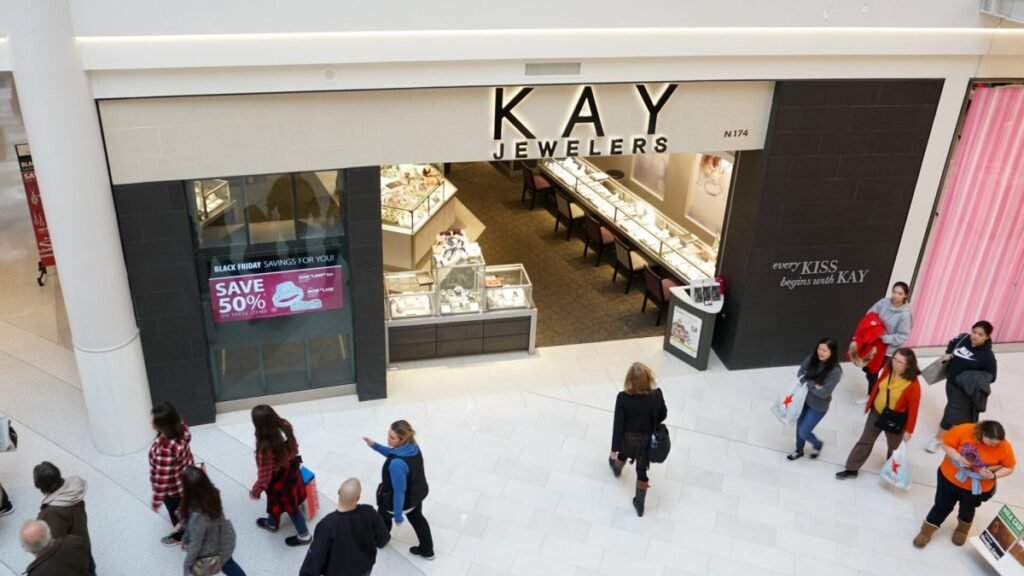
Following a comprehensive review, the company identified opportunities to integrate smaller brands into its larger, more established banners. Going forward, Signet will prioritize its three core brands: Kay Jewelers, Zales, and Jared.
Strategy goals
- Concentrate resources on top-performing brands
- Improve operational efficiency
- Expand customer reach
- Drive more consistent comparable sales growth
Signet operates nearly 2,600 locations across several banners, including Kay Jewelers, Zales, Jared, Banter by Piercing Pagoda, Diamonds Direct, Blue Nile, James Allen, Peoples Jewellers, and Rocksbox in North America, as well as H.Samuel and Ernest Jones in the U.K.
Brands integration moves
- James Allen will become a proprietary collection within Blue Nile, with its standalone website scheduled to shut down in the second fiscal quarter of 2027.
- Rocksbox will be integrated into Kay Jewelers in fiscal 2026.
Meanwhile, Signet will maintain its U.K. brands and Peoples Jewellers, as they are performing well and remain generally self-sustaining.
“We believe the cash generation from these businesses as well as the potential tax cost of exiting these brands significantly outweighs any potential sale proceeds,” said Signet Chief Operating & Financial Officer Joan Hilson in the earnings call.
The company also added that it will continue evaluating the long-term role of Banter.
Signet confirms store closures and real estate optimization
As part of its restructuring, Signet plans to close approximately 100 stores in fiscal 2027 while accelerating renovations across its remaining fleet.
The company aims to renovate nearly 10% of its stores, about 30% more locations than previously planned, after seeing modest same-store sales improvements from updated formats.
As of Jan. 31, 2026, Signet operated 2,582 total locations, including 2,238 in the U.S., 91 in Canada, and 253 internationally, according to its 10-K filing.
The company has not disclosed which specific stores will shutter, but the closures are expected to focus on underperforming locations, particularly those outside its core brands or in declining retail environments.
Signet noted that all real estate decisions are guided by strict financial and operational criteria, including local market potential and mall performance.
The company said it continues to “rationalize its store footprint” to improve productivity, reduce exposure to weaker malls, and enhance the in-store experience.
Shutterstock
Signet financial performance highlights
For the fourth quarter of fiscal 2026:
- Same-store sales declined 0.7% year over year.
For the full fiscal year 2026:
- Same-store sales increased 1.3%.
- Core brands (Kay Jewelers, Zales, and Jared) delivered more than 3% same-store sales growth and accounted for roughly 70% of revenue.
Profitability improved significantly:
- Operating income rose to $393.1 million, or 5.8% of sales, up from $110.7 million, or 1.7%, of sales the prior year.
However, e-commerce performance weakened in the full fiscal year 2026:
- Online sales declined 2.4%.
- Digital accounted for 21.8% of total sales, down from the previous year.
The decline was primarily driven by underperformance in James Allen, which also reported negative comparable sales.
Signet’s strategy for fiscal 2027
Signet unveiled its three-pillar strategy for fiscal 2027 as it navigates rising gold prices, tariffs, and economic uncertainty. The initiative is expected to be completed by the third quarter of fiscal 2027.
- Strengthen core performance
Sharpen brand differentiationExpand customer reach
Enhance omnichannel integration across physical and digital channels
- Leverage scale for greater efficiency
Increase inventory turnoverReduce tariff and commodity cost exposure
Optimized pricing strategies based on customer demand
- Restructure the operating model
Execute strategic real estate actionsContinue portfolio optimization
Build a higher-performing organization
Rising costs and strategic shifts across the jewelry industry
Recent moves across the industry show similar pressures. Pandora, the world’s largest jewelry brand, recently introduced platinum-plated collections in select lines as it seeks to reduce reliance on silver following sharp price increases.
Analysts say the price surge in precious metals is due to ongoing geopolitical tensions, trade tariff disputes, and concerns over the Federal Reserve rate cuts and a weakening U.S. dollar, as reported by The Economic Times.
Some market experts argue that precious metals are evolving from alternative investments into essential portfolio holdings amid economic uncertainty.
More Retail Business News:
- Kohl’s shares surprising store closure news
- Walmart quietly adds upscale brands
- 106-year-old retail brand operator closing all stores in bankruptcy
Other analysts believe diversification into alternative materials could become a blueprint for the broader jewelry industry.
“Companies highly exposed to silver might face margin compression if they cannot pass costs through to consumers, while those that successfully shift to alternative materials or mixes could better protect profitability and price‑value perception,” said TipRanks analysts.
What this means for the jewelry industry
Signet’s restructuring highlights a turning point for the jewelry industry.
As gold prices climb and lab-grown diamonds reshape consumer demand, traditional retailers are being forced to adapt both operationally and strategically. Companies that can balance cost pressures, evolving material trends, and shifting consumer preferences are likely to be better positioned to sustain growth.
This dynamic suggests that scale, pricing flexibility, and brand positioning will become increasingly important as traditional diamond retailers navigate a structurally changing market.
Related: Apple closes all stores in fast-growing market