
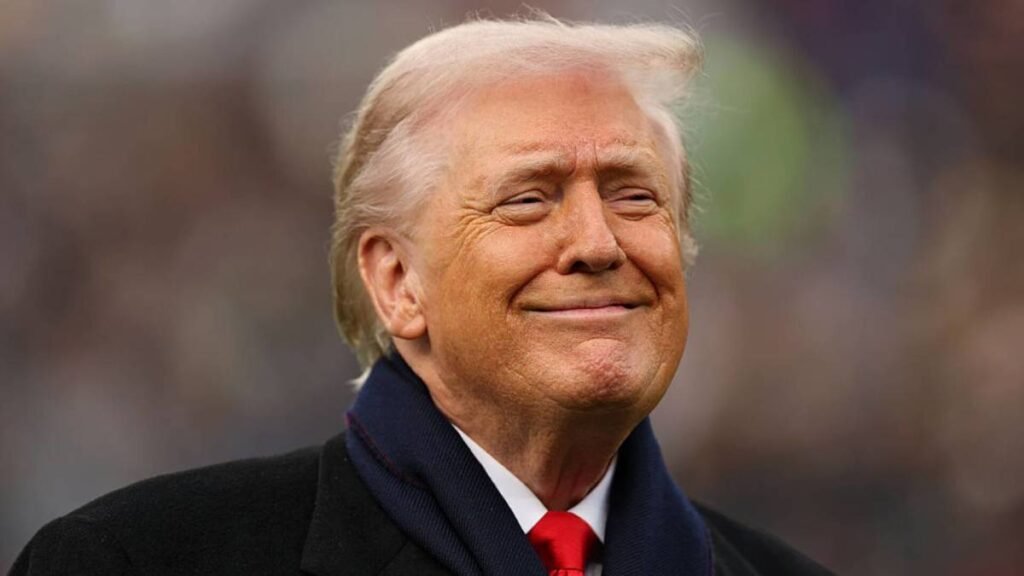
If you scroll markets Twitter long enough, some clips become familiar.
One of them is Donald Trump saying he built “the strongest economy in history” with “no inflation” and “the highest stock market ever” in a sound bite Watcher.Guru pushed out again on X (formerly Twitter).
Trump has used versions of that line for years, including telling CBS in a “60 Minutes” interview that “we had the greatest economy in the history of our country” when talking about his first term.
He doesn’t stop there.
At Davos this year he told the World Economic Forum that “growth is exploding, productivity is surging, investment is soaring, incomes are rising, inflation has been defeated,” calling it “the fastest and most dramatic economic turnaround in our country’s history,” highlighted in my TheStreet coverage.
You may agree or roll your eyes, but if you have money in the market, you feel those words in your stomach, not just in your politics.
Smith/Getty Images
Hearing his message the way a bear does
When I listen to Trump talk about the economy, I don’t just hear red‑meat applause lines. I hear a direct challenge to anyone who has doubted this market, or sat on the sidelines waiting for the crash that never quite arrives.
In his latest State of the Union, Trump described a “turnaround for the ages” and ticked through improvements in inflation, gas prices, jobs and the stock market, painting a picture where his policies rescued a country in crisis, said The New York Times in its fact‑check of the speech.
Trump “cited a long list of economic positives…and the data backs him up on most of it,” even as it noted that many households did not feel as optimistic as the numbers implied, according to TheStreet’s write‑up of his economic messaging.
MoreEconomy:
- Goldman Sachs resets oil-price bets as war rages on
- How Fed meeting impacts mortgage rates, housing market
- IMF drops blunt warning on US economy
For a natural bear, that’s a taunt.
The subtext is simple: you said inflation would run away, tariffs would break the recovery, valuations were unsustainable, and yet the indexes are near records. It’s a scoreboard speech dressed up as a victory lap.
What the numbers actually say to me
Because I write about money, I don’t get to stop at the speech. I go hunting for the data behind the swagger, and that’s where the clean “strongest in history” story starts to fray.
At Davos, Trump said “inflation has been defeated” and pointed to a three‑month run where core inflation averaged about 1.6%, but Capital Economics economist Thomas Mathews called that “factually incorrect,” saying inflation was “still concerningly elevated” for households, according to TheStreet’s reporting.
Inflation in Trump’s State of the Union wasn’t really “plummeting” the way he claimed, because even with the headline rate down near 2.4%, prices for groceries, electricity, housing, and medical care were still rising faster than that, according to PBS.
He also overstated the size of his tax cuts, exaggerated how bad the economy was when he took office, and treated cheaper gas as something the White House delivered rather than a normal outcome of global energy markets, according to NPR’s annotated fact‑check of the same speech.
Once I line those pieces up, I see an economy that’s solid and improving in key ways, not some unprecedented miracle without inflation.
Why his line still hits when you check your balance
Even when I know the numbers, I understand why his boast lands. You don’t live inside a fact‑check; you live inside your bank app and your monthly bills.
Goldman Sachs chief economist Jan Hatzius described the backdrop when Trump returned to office as a “sweet spot of healthy growth and gradual disinflation” and estimated real GDP growth at about 2.6%, expecting a similar pace the following year, according to a research note cited by TheStreet.
That isn’t “greatest in history,” but it is the kind of environment where broad index investors quietly see new highs in their accounts even as they grumble at the supermarket checkout.
Higher‑income households with stock and home equity are feeling wealthier while lower‑ and middle‑income families still report feeling behind as prices stay elevated, a split that recent coverage at TheStreet has described as a “K‑shaped” reality.
That lines up with what I hear from readers who tell me, “my portfolio looks fine, but my life is expensive,” a sentence that holds two truths at once.
So when Trump says there’s “virtually no inflation” and that “stock markets are continually hitting record highs,” as he did in a recent speech captured, he’s pressing on the part of you that sees your balance and wants to believe the pain phase is finally over.
If you’ve been bearish and underweight risk while that balance rises for your friends and coworkers, his confidence can feel like a dare.
How I translate the spin into something useful for you
Here’s what I do with all of this when I sit down with my own accounts. I treat Trump’s boasts as sentiment signals, not as an investment thesis.
When he says “we had the greatest economy in the history of our country,” I hear a politician trying to claim credit for a complicated mix of monetary policy, demographics, post‑pandemic normalization, and animal spirits, not a portfolio manager handing me a backtested strategy.
When he claims “inflation has been defeated” or is “plummeting,” I look at the fact‑checks from PBS, NPR, and others and remind myself that 2% to 3% inflation on a permanently higher price level still feels painful if your wages or business revenue haven’t kept pace.
For you and me, that suggests a few habits worth building:
- Use speeches as a trigger to check data, not to change allocations on the spot, leaning on independent sources before you decide you were “wrong” or “right.”
- Separate your feelings as a consumer from your job as an investor, recognizing that both can be true: your grocery bill hurts, and your index fund is finally working again.
- Notice when ego is driving your stance: being a proud bear who misses a multi‑year rally can hurt you more than admitting the tape doesn’t care about anyone’s narrative.
Trump’s latest eye‑popping boast will not be his last. Fact‑checkers will keep grading his claims, and economists will keep arguing about how much credit or blame he deserves.
You don’t control any of that. What you do control is how tightly you cling to a story once the numbers stop backing it up.
If there’s a message for bears hidden in his bragging, it’s this: the market doesn’t pay you for winning arguments; it pays you for surviving long enough to let compounding work, no matter who is standing at a podium taking a victory lap.
Related: U.S. economy will show resilience, despite rising oil prices