
Sam Walton never forgot who the top dog in his operation was.
“There is only one boss: the customer,” the Wal-Mart (WMT) co-founder once said. “And he can fire everybody in the company, from the chairman on down, simply by spending his money somewhere else.”
Customers have been spending their money at Walmart for more than six decades as the retail giant grew into the world’s largest company by revenue — until being surpassed by Amazon (AMZN) in 2026.
In February 2026, Walmart joined the trillion-dollar club, pushing its market value above $1 trillion and putting its total market worth above the annual gross domestic product (GDP) of many countries.
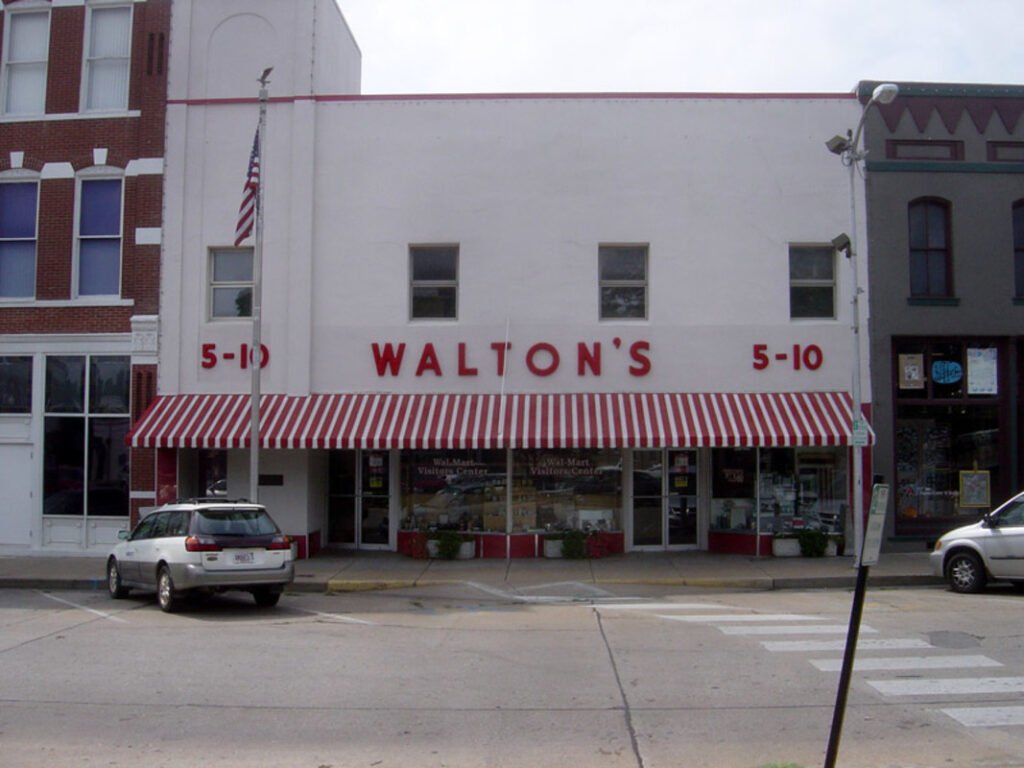
The first Walmart store, officially named Wal-Mart Discount City, opened on July 2, 1962, in Rogers, Arkansas.
The location pioneered Walton’s strategy of high-volume sales through low prices and excellent customer service in rural, underserved areas.
Walton, who died in 1992, believed that if he offered prices as good as or better than stores in cities that were four hours away by car, people would shop at home — and that idea has paid off.
Bobak, CC-BY-SA-2.5 via Wikimedia Commons
Is Walmart the world’s largest employer?
Roughly 95% of U.S. consumers shop at Walmart at least once or twice a year. As of 2026, Walmart served more than 190 million Americans each month, underscoring its massive reach.
Walmart is also the largest private employer in the world, with about 2.1 million people — roughly the population of Houston — on its payroll.
Related: History of Coca-Cola: Timeline, facts & milestones
Does Walmart own Sam’s Club?
On April 7, 1983, Walton tried a little experiment, launching the first Sam’s Club, a membership-based retailer designed to help small business owners purchase products in bulk, in Midwest City, Oklahoma.
By any measure, the experiment was a rousing success.
Sam’s Club now has more than 69 million members, and the company is pursuing a 10-year goal to double membership and sales, supported by plans to open 30 new locations and remodel its roughly 600 existing U.S. clubs.
Things were going so well that Walton performed a hula dance on Wall Street on March 15, 1984, honoring a promise to employees after Walmart hit an 8% pre-tax profit target in 1983.
He also promised never to do it again.

Rick T. Wilking/ Getty Images
Walmart’s stock, IPO & addition to the Dow
The company went public on October 1, 1970, offering 300,000 shares at an initial price of $16.50 each.
On March 17, 1997 — St. Patrick’s Day — Walmart joined the Dow Jones Industrial Average, replacing Woolworth Corp. as part of a modernization effort to include more tech and service-oriented companies.
The retailer officially changed its legal name from Wal-Mart Stores, Inc. to Walmart, dropping the hyphen and “Stores,” effective February 1, 2018.
While remaining in the Dow, Walmart moved its stock exchange listing from the New York Stock Exchange (NYSE) to the Nasdaq Global Select Market on December 9, 2025, reflecting its growing focus on technology and artificial intelligence.
The company has expanded aggressively into technology, from launching its e-commerce platform in 2000 to investing in AI and drone delivery.
More Dow Jones company histories:
- From bulldozers to AI: Caterpillar’s history & next chapter
- History of Chevron: Company timeline & facts
- History of Microsoft: Company timeline & facts
Walmart’s stock split history
Walmart has executed 12 stock splits since its IPO.
Eleven were 2-for-1 splits, and the most recent was a 3-for-1 split on February 26, 2024.
How is Walmart’s stock doing?
In fiscal 2025, the retailer reported total revenue of $681 billion, a 5.1% increase from the previous year, driven by strong e-commerce sales, which grew 20.8% in the U.S., and a 27% increase in global advertising.
Net income totaled $19.4 billion, up 25.3% from the previous year.
Related: Walmart sees troubling shift in consumer behavior
“Our mission to help people save money and live better is as true today as it’s ever been,” said John Furner, president and CEO, during Walmart’s fourth-quarter earnings call. “It guides the strategy we’ve outlined, and that strategy is clear. We’re executing on it at a high level.”
Walmart’s massive footprint has even led some analysts to view it as an economic indicator.
Of course, an organization of this size is bound to spark some controversy, and the company has faced criticism over such issues as anti-union efforts, low wages, and gender and racial discrimination.
The retailer has also given rise to the so-called “Walmart Effect,” describing the profound economic impact its stores can have on communities — often lowering prices and consumer costs, but also putting pressure on local businesses and wages.
Related: History of Apple: Company timeline and facts
Nevertheless, analysts cite Walmart’s “wide economic moat” and believe the company will remain competitive given its scale and continued investments in technology and infrastructure.
The retailer continues to gain share with higher-income consumers through faster delivery offerings while maintaining its appeal to lower-income shoppers with everyday low prices.
“I’m excited about what’s to come and the plans we have to grow the business as we look ahead,” Furner said.
Sparky: Walmart’s AI shopping tool
He added that the company is “seeing good momentum” from Sparky, the company’s AI-powered shopping tool.
“Customer engagement is up, and customers who use Sparky have an average order value about 35% higher than non-Sparky customers,” he said.
A timeline of Walmart’s milestones
- July 2, 1962: Sam Walton opens the first Walmart store in Rogers, Arkansas.
- October 1, 1970: Walmart goes public, offering 300,000 shares at $16.50 each.
- August 25, 1972: Walmart is listed on the New York Stock Exchange.
- January 31, 1980: Walmart reaches $1 billion in annual sales.
- April 7, 1983: Walmart’s first Sam’s Club opens in Midwest City, Oklahoma.
- March 15, 1984: Sam Walton performs a hula dance on Wall Street to honor a profit target.
- March 1, 1988: The first Walmart Supercenter opens in Washington, Missouri, combining a full-scale supermarket with general merchandise.
- March 17, 1997: Walmart joins the Dow Jones Industrial Average, replacing Woolworth.
- January 3, 2000: Walmart launches an expanded version of Walmart.com, marking its push into e-commerce.
- April 1, 2002: Walmart first tops the Fortune 500 ranking of America’s largest companies.
- November 22, 2021: Walmart launches its first commercial multi-site drone delivery operations.
- February 1, 2018: Walmart officially changes its legal name from Wal-Mart Stores, Inc. to Walmart.
- December 9, 2025: Walmart moves its stock exchange listing from the NYSE to the Nasdaq Global Select Market.
- June 6, 2025: Walmart launches its generative AI-powered shopping assistant, Sparky.
Related: History of Nike: Company timeline and facts