
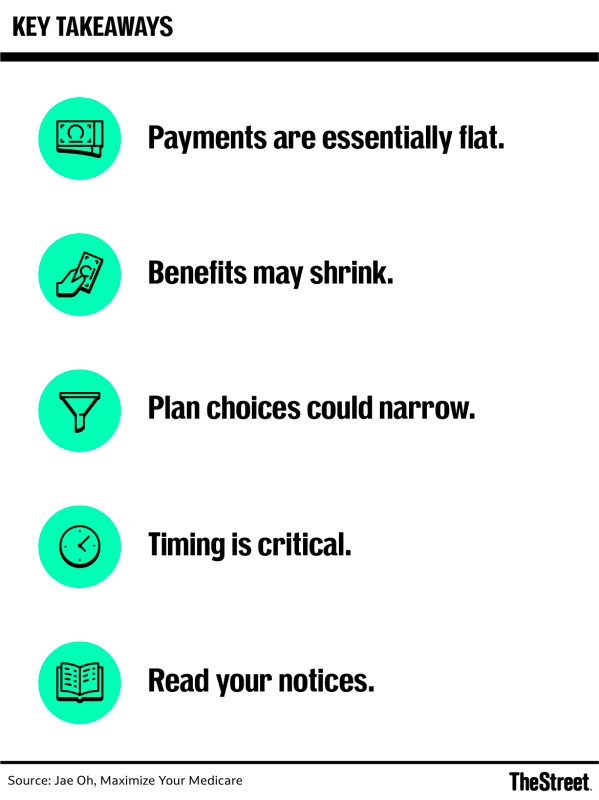
A proposed update to Medicare Advantage payment rates for 2027 is sending a clear signal to beneficiaries: Expect continued pressure on premiums and benefits.
The federal government has proposed a 0.09% increase, or a roughly $700 million jump, in payments to Medicare Advantage plans, said Jae Oh, author of “Maximize Your Medicare,” in an interview with TheStreet. That effectively means flat funding at a time when health care costs continue to rise faster than inflation.
Below is a transcript of that interview, edited for clarity and brevity.
What a near-flat increase means for Medicare beneficiaries
Robert Powell: Medicare Advantage payments for 2027 are proposed to remain nearly flat, with a net average increase of only 0.09%, or about $700 million, if my numbers are correct. Here to talk with us about what that means is Jae Oh, author of “Maximize Your Medicare.” Jae, welcome.
Jae Oh: Thanks for having me, Bob.
Why Medicare Advantage payment rates matter
Robert Powell: Walk us through this. Why do we need to pay attention to Medicare Advantage payment rates?
Jae Oh: For newcomers, Medicare Advantage plans receive payments from the federal government. These payments are funded primarily through payroll taxes that support the Medicare system, along with some discretionary federal spending for Part B and Part D. Part A is funded through the Medicare trust fund.
There has been a lot of attention on Medicare Advantage over the past couple of years, including high-profile settlements and controversies. But at its core, the amount paid to carriers is set annually for a base case. For an average 65-year-old enrollee, that payment is expected to increase by less than 1% in 2027 compared with 2026.
The issue is that health care costs are rising much faster than general inflation. If payments to carriers are essentially flat while costs are rising, that creates pressure on Medicare Advantage plans. There is no real way around that conclusion.
Potential impact on premiums and benefits
Robert Powell: Given that, do you expect beneficiaries will see higher premiums or fewer benefits, such as dental or vision coverage?
Jae Oh: We are already seeing that in 2026. Many beneficiaries discovered that benefits they expected, such as dental, vision or over-the-counter allowances, had changed. Those changes were disclosed, but many people did not notice them until after enrollment.
If payment rates remain near flat, it is reasonable to expect continued pressure. That could mean reduced benefits, higher costs or both, depending on the market. In some areas, carriers may reduce the number of plans offered or exit markets altogether. That trend could continue.
Switching Medicare plans and key enrollment windows
Robert Powell: Some beneficiaries may have the option to switch plans or move to Original Medicare with a Medigap policy. But those decisions require careful evaluation, correct?
Jae Oh: That is correct. The window for switching Medicare Advantage plans earlier in the year has already passed. There are limited exceptions, such as moving into a five-star plan.
For most people, the next opportunity comes during the annual enrollment period, which begins Oct. 15. That is when beneficiaries can evaluate their options, including switching to Original Medicare with a Medigap policy and a standalone Part D plan.
Industry scrutiny and consumer protections
Robert Powell: Medicare Advantage providers have also been in the news over allegations of upcoding and regulatory scrutiny. At the same time, some argue that lower payment rates are squeezing margins. How should consumers think about that?
Jae Oh: It is a complicated and sometimes confusing situation, even for professionals. For consumers, the key point is this: If you are enrolled in a plan, the likelihood that the carrier will fail to deliver the contracted benefits is extremely low.
Plans operate under strict regulatory oversight. They must comply with federal and state rules and deliver the benefits outlined in their contracts. Issues such as upcoding are being addressed by regulators and are not something individual beneficiaries need to resolve.
Competition and market dynamics
Jae Oh: It is also important to remember that Medicare Advantage is highly competitive. Carriers operate in markets where multiple well-resourced competitors are offering plans. That competition limits the ability of any single insurer to make drastic changes in isolation.
In simple terms, just as one gas station cannot raise prices dramatically without considering nearby competitors, Medicare Advantage carriers must remain competitive in its pricing and benefits.
What Medicare beneficiaries should do now
Robert Powell: So the key takeaway is to stay informed and review plan notices carefully?
Jae Oh: Yes. Beneficiaries should pay attention to updates and review their annual notices of change, which typically arrive in September and October. That is the best way to understand how their plan may change for the following year.
Related: Protect yourself from rising Medicare fraud