
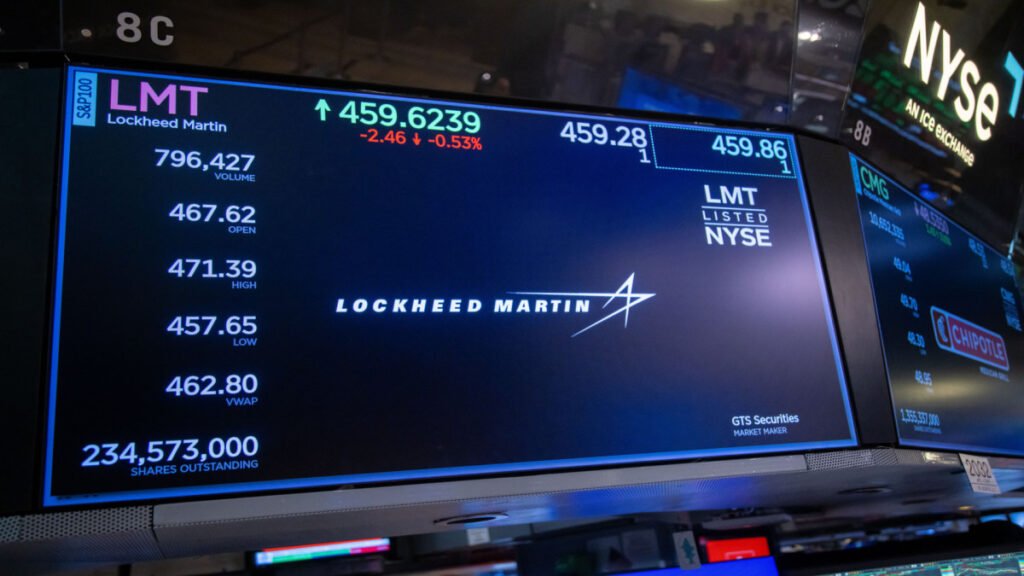
Morgan Stanley reiterated its Equalweight rating and $675 price target on Lockheed Martin (LMT) following the company’s announcement of a new framework agreement with the Department of War to quadruple production of the Precision Strike Missile.
LMT shares were trading at $621.73 at the time of the note, up 27% over the past six months. The $675 target implies approximately 8.5% upside from that level. Morgan Stanley described the deal as consistent with and additive to Lockheed’s broader munitions acceleration strategy.
What the Precision Strike Missile deal involves
Lockheed Martin and the Department of Defense announced the agreement on March 25. It builds on a previous $4.94 billion contract awarded by the US Army last year and together the two actions will quadruple PrSM production capacity, from approximately 400 to 1,600 units per year.
The agreement also establishes the potential to negotiate a multi-year contract of up to seven years, subject to congressional authorization. That structure gives Lockheed and its subcontractors the long-term demand signal needed to invest in factory expansion and automation.
More Tech Stocks:
- Morgan Stanley sets jaw-dropping Micron price target after event
- Nvidia’s China chip problem isn’t what most investors think
- Quantum Computing makes $110 million move nobody saw coming
“Lockheed Martin delivers the advanced precision fires capabilities the warfighter needs, including the Precision Strike Missile, which expands deep-strike capability,” said Lockheed Martin Chairman, President and CEO Jim Taiclet. “We are working closely with the Department of War and the U.S. Army to build the Arsenal of Freedom.”
Michael Duffey, undersecretary of defense for acquisition and sustainment, added: “By empowering industry to invest in the factory floor, we are building a decisive and enduring advantage for our warfighters to outpace any potential adversary.”
Why Morgan Stanley sees this as a positive signal
Morgan Stanley noted that the PrSM deal is part of a broader pattern of multi-year agreements between the Pentagon and Lockheed that are shifting the funding environment for the company’s missile programs.
The firm had previously noted similar deals: a separate framework to triple PAC-3 MSE interceptor production and another to quadruple THAAD interceptor production capacity. Together, Morgan Stanley said these agreements signal “structurally higher” Department of War demand for missile systems while improving outyear funding and production visibility.
Nagle/Getty Images
The bank sees two specific benefits for Lockheed from this environment. First, greater funding certainty allows the company to invest in facilities, supply chains, and workforce without the risk of sudden budget cuts. Second, higher production rates create the potential for margin expansion as fixed costs are spread across greater volumes.
What is driving the urgency on the Pentagon side
The timing of the agreement reflects a specific operational context:
- Combat debut. On March 4, US Central Command confirmed PrSM’s debut in combat during Operation Epic Fury, the US-Israel campaign targeting Iran’s military infrastructure.
- Stockpile pressure. Morgan Stanley explicitly flagged “increasing concern around pressure on U.S. stockpiles as a result of the ongoing conflict with Iran” as a factor reinforcing urgency around both replenishment and capacity expansion.
- Replacing ATACMS. PrSM is designed to succeed the Army Tactical Missile System with extended range, improved lethality, and greater platform versatility. The quadrupling of production directly addresses the gap left by the system it replaces.
The agreement is not isolated. DefenseScoop reported that the Pentagon simultaneously announced agreements with BAE Systems on THAAD seeker production and with Honeywell, which committed $500 million of internal investment toward munitions components including navigation systems, actuators, and electronic warfare solutions.
What this means for LMT investors
Morgan Stanley’s Equalweight rating means the firm does not view LMT as materially undervalued at current levels relative to peers. The $675 target reflects the bank’s view that the stock is fairly priced given the visible earnings drivers, but that the structural improvement in Pentagon demand is real and durable. For investors already holding LMT, the note reinforces the thesis. For those considering entry, Morgan Stanley’s message is essentially that the stock is not cheap, but the multi-year revenue visibility from these munitions deals is genuinely improving.
Lockheed noted it has invested $7 billion since President Trump’s first term to expand production capacity for key systems, including approximately $2 billion focused on munitions output. The company currently has more than 115,000 square feet of dedicated PrSM production space in the US and more than 400 employees supporting the program, with plans to expand the workforce further to meet demand.
Related: Morgan Stanley resets bets on defense stocks amid war