
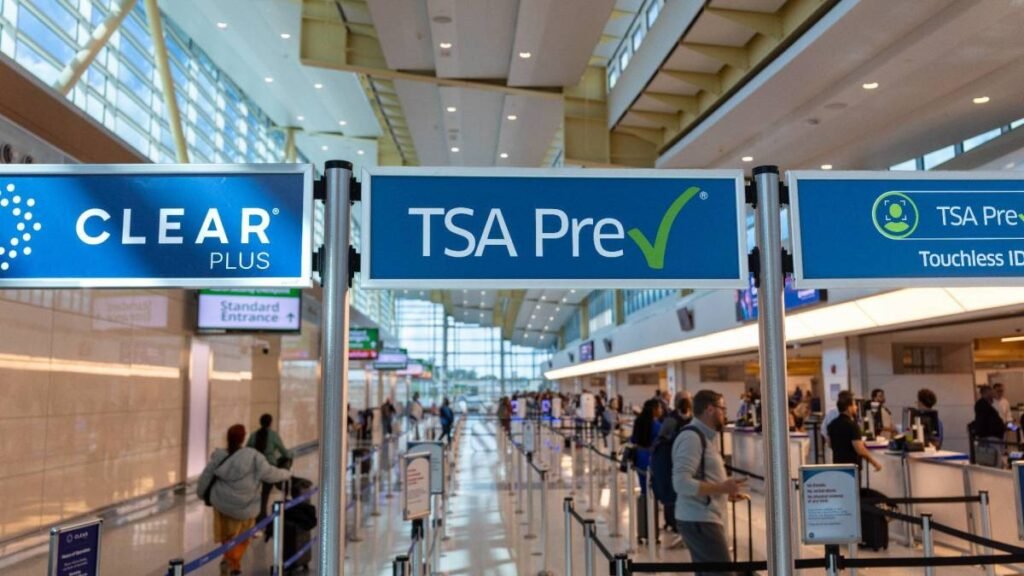
Travel disruptions tied to the partial government shutdown and funding shortfalls at the Transportation Security Administration (TSA) have escalated just as spring break travel ramps up.
The result has been widespread delays at airports across the U.S.
Airport wait times have reached the highest levels in the agency’s history, with some lines exceeding four hours, according to testimony from TSA Deputy Administrator Ha Nguyen McNeill before Congress on March 25.
Even the roughly 20 million Americans the TSA says have PreCheck credentials have not been immune, TSA data show. In recent weeks, airlines and airports have advised passengers to show up at least two or three hours before a flight.
A publicly traded company offering expedited airport screening is benefiting from the partial government shutdown, as TSA staffing shortages have contributed to hourslong lines at airports across the U.S.
Shares of Clear Secure rose 11% earlier this week and are up roughly 60% over the past month, according to reporting by The Wall Street Journal.
Even though early Friday, March 27, the U.S. Senate agreed to fund the Department of Homeland Security, which in turn will bring TSA workers back to work, there will likely be a lag as things get back to normal. People with Clear access are likely to continue seeing shorter checkpoint wait times.
What is Clear expedited airport screening?
Clear speeds up the airport security process by using biometric identifiers, including fingerprints or iris scans, instead of traditional ID checks. After enrolling, travelers can use dedicated Clear lanes at many major airports (it’s not typically found at small regional airports), where their identity is verified instantly at a kiosk and they are escorted to the front of the security line.
Unlike TSA PreCheck, which speeds up the physical screening process (i.e., allowing people to keep shoes and belts on and leaving laptops and tablets in bags), Clear lets travelers skip the ID check portion.
Clear typically costs about $189 per year, making it especially useful for frequent flyers or people who travel during busy times of year.
Related: What flyers need to know about huge TSA airport delays
While Clear has benefited from the most recent government shutdown, the company’s reaction has been muted.
“We hope a resolution comes soon,” Clear’s Executive Vice President of Aviation Kyle McLaughlin said in a statement to the Wall Street Journal. “We are working hard to support all our stakeholders, including airlines, airports, the TSA, and most importantly, American travelers who deserve better.”
The company also reportedly donated $200,000 worth of gas and grocery cards to TSA workers.
Clear’s business model
Clear was founded in 2003, filed for bankruptcy in 2009, and was relaunched in 2012 under new ownership. The revamped company has since grown under the leadership of CEO Caryn Seidman-Becker, who played a key role in rebuilding and expanding the business.
Clear operates on a subscription model and also partners with airports, airlines, and credit card companies. Over time, the company has expanded beyond airports into stadiums, event venues, and broader identity verification services.
The company went public in 2021 on the New York Stock Exchange under the ticker symbol “YOU.”
Clear recent financial growth
According to company filings and disclosures:
- 2024: Quarterly revenues are growing about 20-25% year over year in multiple quarters.
- 2025 (full year): Revenue was approximately $900.8 million (+16.9% YoY).
- 2026: Clear stock is up 50% year to date, according to The Wall Street Journal.
Membership growth
- Total users reached about 38 million (up approx. 31% YoY), but this total includes free users and people who use Clear in stadiums and venues other than airports.
- Clear has more than 7 million CLEAR+ members who use the service for airline travel, according to SEC filings.
“I think it remains to be seen if there’s appetite for paid add-ons, especially since many customers are getting CLEAR+ for free. However, maybe there’s an appeal in the so-called ‘luxury travel’ business for a wealthy enough person to skip the ‘skipping line,’ or have somebody carry your bags for you. We might be surprised by the success of this ‘add-on’ product,” wrote Noah Weidner of TheStreet Pro.
Getty Images
Clear is free with some American Express cards
Several American Express cards offer statement credits to use for Clear accounts. These include:
- The Platinum Card from American Express
- The Business Platinum Card from American Express
- American Express Green Card
- Hilton Honors American ExpressAspire Card
- Centurion® (Black Card)
Clear vs. TSA PreCheck
If you’re a frequent traveler looking for the most efficient way to get through the airport, you might want to enroll in both Clear and TSA PreCheck. Here is how Clear compares to TSA PreCheck.
Clear
- Speeds up ID check at security using fingerprint or iris scan
- Gets passengers directly to the front of the screening line
- Cost: Approx. $189/year (some Amex cards cover the fee)
- Available at about 60+ U.S. airports and some venues including sports stadiums
- Paid airport members: Approx. 7 million
TSA PreCheck
Following the Sept. 11 attacks, TSA security rules tightened significantly, shaping today’s screening process, including rules around what passengers could and could not pack in carry-ons. The rules continue to change often, such as the one involving portable batteries.
Still, TSA PreCheck can be a timesaver. Some facts about PreCheck:
- Typically provides shorter lines at TSA checkpoints
- Allows passengers to keep shoes and belts on and laptopsin bags
- Cost: $85 for 5 years (about $17 per year)
Related: An unfunded TSA is leaving air travelers stranded in hours-long security lines